
In this article, Emmanouil Kokkinakis (Ph.D. Student), Ioannis Komis (Postdoctoral Researcher) and Prof. Konstantinos G. Makris, investigate wave dynamics in two-dimensional nonlinear non-Hermitian photonic lattices. Their work, recently published in Communications Physics, explores how nonlinearity and non-Hermiticity jointly shape light localization and transport in higher-dimensional systems.
Non-Hermitian photonic lattices, characterized by asymmetric couplings, exhibit the so-called non-Hermitian skin effect, where light accumulates at specific edges or corners of the system. While this phenomenon is well understood in linear systems, its interplay with optical nonlinearity, an inherent feature of photonic platforms, remains largely unexplored, especially in two dimensions.
In this work, the authors demonstrate that Kerr nonlinearity introduces a competing mechanism to the skin effect. For localized excitations, sufficiently strong input amplitudes can induce self-trapping, preventing light from drifting toward the preferred lattice corners. Importantly, the threshold for this transition is not universal: it strongly depends on the position of excitation within the lattice and on the degree of coupling asymmetry. Near corners where linear modes are already localized, self-trapping occurs at relatively low powers, while in the lattice bulk it requires significantly higher amplitudes or may even become impossible.
.
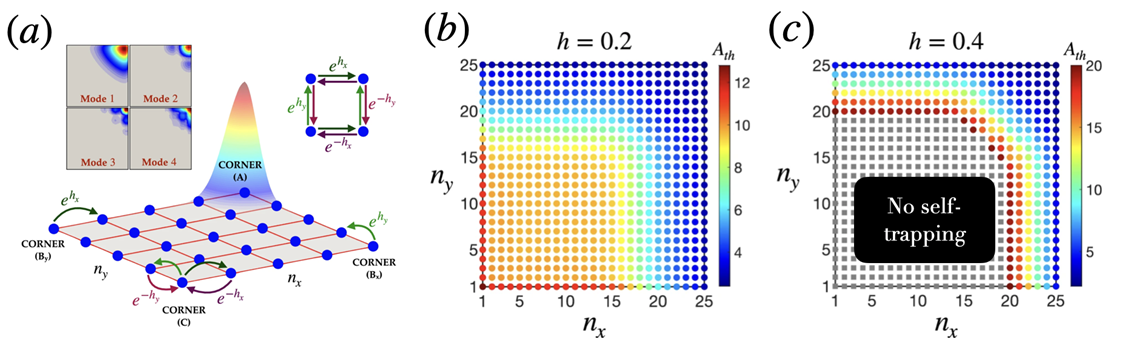
Image: a) Schematic representation of the lattice b) Amplitude threshold for single-site excitation self-trapping (color) for each site of the lattice for a small value of coupling asymmetry h=0.2 c) Same, for higher value of coupling asymmetry h=0.4.
Finally, the authors identify and characterize two-dimensional skin solitons-nonlinear localized states that inherit the spatial asymmetry of the underlying lattice. These solitons exhibit power thresholds and directional localization properties that can be engineered through lattice design, extending the concept of skin modes into the nonlinear regime.
These findings open new avenues for controlling light in complex photonic systems and pave the way for future studies on transport, localization, and nonlinear wave phenomena in higher-dimensional non-Hermitian platforms.
Research article: E.T. Kokkinakis, I. Komis, & K.G. Makris. Self-trapping and skin solitons in two-dimensional non-Hermitian lattices. Commun Phys 9, 22 (2026). https://doi.org/10.1038/s42005-025-02418-1