
Constraining axion-like dark matter with a radio-frequency atomic magnetometer
Adrien Rigoulet, an MSc student from the University of Rennes-Lannion (France), spent six months at the University of Crete carrying out his master's thesis research in the lab of D. Antypas. Working together with S. Nanos, I. Kominis, and D. Antypas, he performed a search for axion-like dark matter using a radio-frequency atomic magnetometer based on spin-polarized rubidium atoms.
Axion-like particles are among the leading candidates for dark matter, the invisible substance believed to account for most of the matter in the Universe. If present in the Galactic dark-matter halo, these particles could generate tiny oscillating magnetic fields that interact with atomic spins.
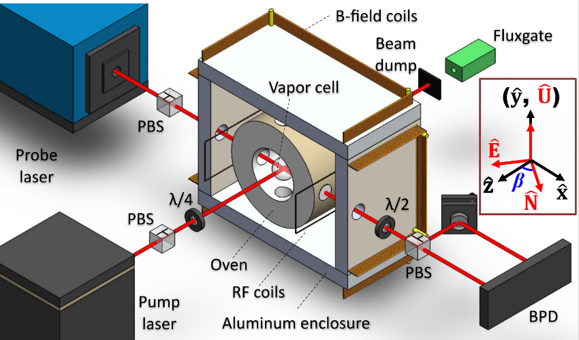 The experiment employed a highly sensitive atomic magnetometer capable of detecting extremely weak oscillating pseudo-magnetic fields over a broad frequency range. By tuning the magnetic resonance of polarized rubidium atoms, the team searched for signatures of axion-like particles interacting with protons, neutrons, and electrons. This approach enabled the exploration of a largely uncharted region of axion masses corresponding to frequencies between 58 and 510 kHz.
Although no dark-matter signal was observed, the measurements established new constraints on the strength of possible axion-like particle interactions with ordinary matter. The results improve previous laboratory limits on axion–proton couplings and provide complementary constraints on axion–neutron and axion–electron interactions.
Beyond the reported limits, the work demonstrates the potential of radio-frequency atomic magnetometers as powerful tools for future dark-matter searches, opening new avenues for laboratory studies of the Galactic dark-matter halo.
Scientific Publication: A. Rigoulet, S. Nanos, I. K. Kominis, and D. Antypas, Constraining axion-like dark matter with a radio-frequency atomic magnetometer. Phys. Rev. D 113, 072011 (2026)