
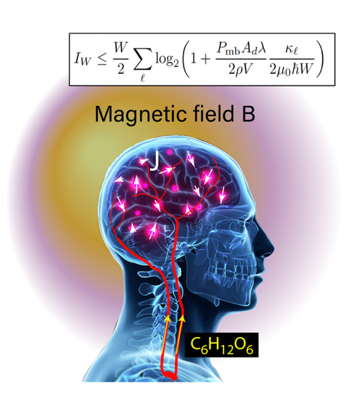
 The senior undergraduate student of our Department, Efthimios Gkoudinakis, together with Shuguang Li and Iannis Kominis, have derived a fundamental quantum limit to the information capacity of magnetoencephalography (MEG), the leading noninvasive technique for measuring brain activity through magnetic fields generated by neural currents. The work establishes a universal and technology-independent bound linking three fundamental ingredients: the metabolic power sustaining neural signaling, the geometry of electromagnetic field propagation, and the quantum energy-resolution limit of magnetic sensing.
Using a continuum operator formalism based on the lead-field covariance operator, the study demonstrates that the externally measurable magnetic field possesses a finite spatial bandwidth, implying that only a limited number of independent spatial modes can be experimentally accessed. The analysis further reveals a fundamental spatiotemporal trade-off: increasing temporal bandwidth inevitably reduces the accessible spatial complexity due to the quantum-limited growth of measurement noise.
For representative human-brain parameters, the theory predicts a maximum MEG information rate of approximately 2.2 Mbit/s and an intrinsic spatial resolution scale of order 1 cm. These results establish an information-theoretic Nyquist scale for MEG and provide a quantitative bridge between neuroscience, quantum metrology, and the physics of information.
Beyond its implications for next-generation MEG instrumentation and quantum-enhanced neuroimaging, the work introduces a broader conceptual framework connecting biological energy consumption, physical observables, and the quantum limits of measurement in complex living systems.
Scientific Publication: E. Gkoudinakis, S. Li, and I. K. Kominis, Metabolic quantum limit to the information capacity of magnetoencephalography, Physical Review Research 8, 023267(2026).
Popular Summary: Gist Science